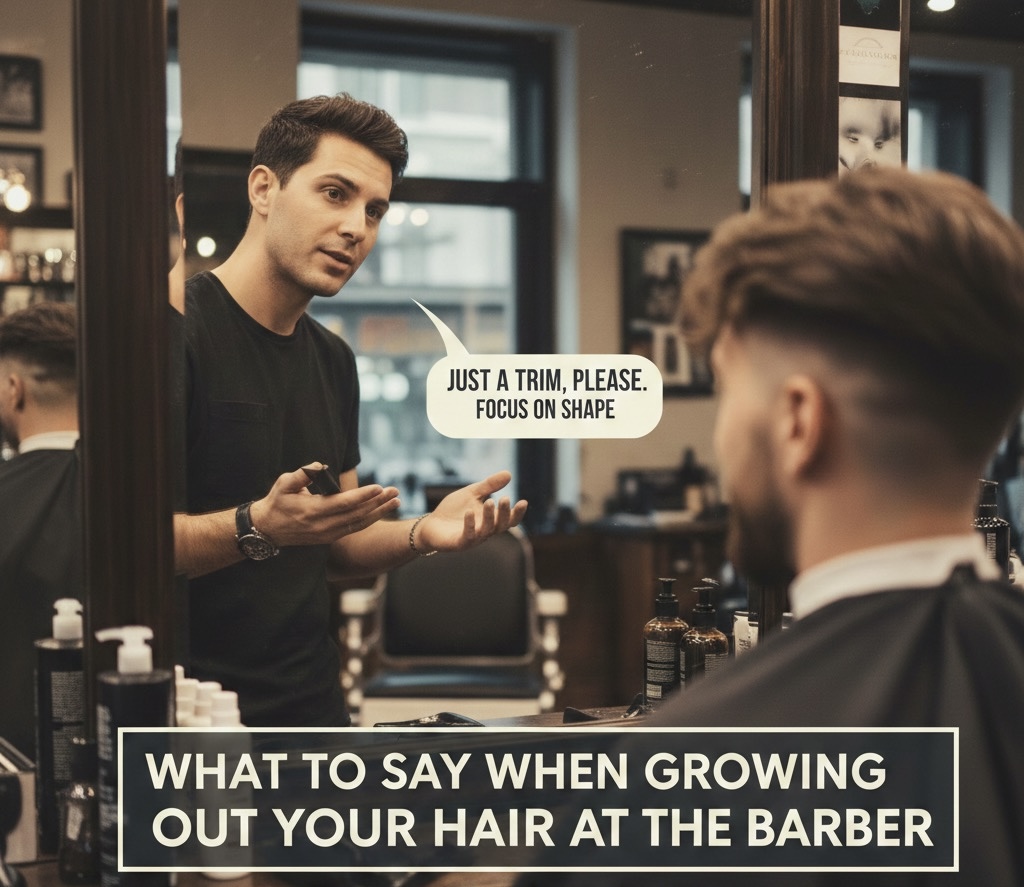
Growing out your hair can feel awkward to explain at the barber. You may worry about losing length, having an uneven shape, or sounding indecisive when you ask for changes mid-process.
Simple, clear wording helps because it makes your goal visible and gives the barber practical instructions to protect length while keeping you neat. When you say what you mean, you reduce the chance of miscommunication and make the appointment less stressful.
This article gives straightforward phrases and short explanations you can use at the barber while growing out your hair, plus things to avoid and practical tips for the conversation.
Why This Moment Matters
Growing your hair out is both a styling and maintenance process. Barbers need to balance preserving length with removing damaged ends, keeping proportions, and managing bulk so your hair still looks intentional between longer cuts.
How you describe your goal affects the haircut decisions your barber makes — from how much to take off, to whether to maintain a fade or switch to a tapered neckline. Clear, simple language keeps the outcome aligned with your timeline and helps the barber offer the right techniques, like point-cutting, texturizing, or light trimming.
Useful Things to Say
Simple Responses
- “I’m growing it out — don’t take off length.” A direct statement that sets the main goal and prevents the barber from cutting more than you want.
- “Just a light trim.” A short request that signals you want minimal change, usually around a quarter- to half-inch off the ends.
- “Neaten the edges only.” Tells the barber to clean up hairline and sideburns while leaving overall length intact.
- “Keep the top long.” Makes it clear you want to preserve the top while they work on the sides or back.
- “Please avoid a full reshape.” Prevents the barber from altering the basic silhouette while you’re in the growing phase.
- “No clipper guard changes on top.” A practical request to avoid unexpected shortness if clippers are about to be used.
Supportive Responses
- “Can you thin the bulk but not shorten it?” Indicates you want reduced weight or volume without losing visible length, useful for thick hair.
- “Please focus on split ends and shape.” Guides the barber to target damaged ends and maintain a tidy silhouette rather than reducing length overall.
- “Leave an inch/two inches and clean up the perimeter.” Gives an exact measurement so the barber knows what “light trim” means to you.
- “I’d like the fade softer so it grows out cleanly.” Asks for a low-maintenance transition that will look better as length increases.
- “Texturize here but don’t take length from the front.” Points to areas for texturizing while protecting key length that affects your style.
- “Show me what you’d recommend to keep it manageable while growing.” Invites the barber’s expertise while making clear your primary goal is growth.
Empathetic Responses
- “I know it’s a process — thanks for helping it look intentional.” Acknowledges the time it takes and builds rapport with your barber.
- “I get that it might look uneven for a bit; what’s the least-visible option?” Shows you understand transitional stages and asks for a practical approach.
- “I’m trying to avoid taking much off — is that doable?” Opens a gentle dialogue and gives the barber room to explain options or constraints.
- “I appreciate your guidance; I don’t want to sabotage the length.” Validates the barber’s role while reiterating your goal.
- “If you think a little more is necessary, tell me why.” Invites a brief explanation rather than an unexpected change, keeping you in control.
- “I’m OK with a maintenance cut if it helps it grow healthier.” Balances patience with willingness to do small upkeep for long-term results.
Light, Warm Responses
- “Let’s give it a tidy-up that still looks like me.” Friendly and casual, this keeps the mood positive and clear about preserving identity.
- “A little off the ends, lots of thumbs up.” Playful but clear, suitable if you and your barber have a relaxed rapport.
- “Keep the drama in the length, not the cut.” Warm and lighthearted way to ask for minimal intervention.
- “Just enough to keep it neat for the office.” Practical and gentle, aligning style with daily life without sounding demanding.
What Not to Say
- Avoid: “Do whatever you want.” — This gives no guidance and risks losing length you want to keep.
- Avoid: “Just a trim” without specifying how much — It’s vague and can mean different things to you and your barber.
- Avoid: “Don’t touch the sides” when also asking for a clean look — Conflicting instructions create confusion.
- Avoid: “I want it perfect” — Implies an unrealistic outcome during a transitional grow-out phase.
- Avoid: “Make it like [celebrity photo]” without noting differences in hair type — Photos can mislead if your hair texture or growth patterns differ.
- Avoid: “I don’t care” — Signals disengagement and can lead to decisions you won’t like later.
Helpful Tips for Handling the Moment
- Be specific: Use measurements (inches) or clear descriptors like “trim ends” or “tapered, not faded.”
- Speak early: Explain your grow-out plan before the clippers come near your head.
- Listen: Let the barber explain techniques that preserve length; they’ll often suggest the best maintenance route.
- Use body language: Point to photos on your phone and to areas on your head to clarify intent.
- Keep tone calm: A relaxed voice encourages a collaborative approach and reduces pressure.
- Set boundaries: If you don’t want the razor or clippers in certain zones, say so up front.
- Ask for a plan: Request advice on when to return and what to ask for at each stage.
- Confirm before cutting: If the barber suggests more than you expected, ask for a quick recap and approval.
Final Thought
You don’t need perfect phrasing to protect your length — a clear goal, simple measurements, and a calm tone are enough to get the result you want. Being honest about the growing timeline and inviting the barber’s expertise will make the process smoother and help your hair look intentional at every stage.
Let us know in the comments if this has helped or if you’ve got suggestions we can include
About the Author
Helen Bach is a relationship expert and writer who helps people find the right words when it matters most. She studied English and English Literature at the University of Michigan, where she developed a passion for how language shapes love, conflict, and connection.
At whattosaywhen.net, Helen writes clear, down-to-earth advice on what to say in real-life situations—from first dates and tough conversations to breakups and makeups. Her goal is simple: to make talking about feelings less awkward and a lot more honest.
 What to Say When
Leave a comment